
Executive summary. In most real-world buying decisions, MailerLite vs Brevo is not a question of “which tool is objectively better,” but “which operating model fits your business better.” MailerLite is fundamentally a simpler email-first platform that now stretches well beyond newsletters into landing pages, blogs, digital products, paid newsletters, and appointment booking. Brevo is a broader platform from the start: it combines email marketing with CRM, SMS, WhatsApp, push, chat, transactional messaging, and a stronger sales-and-lifecycle orientation. That difference shows up in the user experience, pricing logic, automation depth, reporting style, and ideal customer profile.
For beginners, creators, bloggers, and small teams that want to launch attractive campaigns fast without living inside a CRM, MailerLite will usually feel easier and more focused. For companies that care about multichannel journeys, larger contact databases, website tracking, sales workflows, or transactional email under one roof, Brevo often has the stronger long-term case. Independent testing from EmailTooltester also supports that split: MailerLite is repeatedly praised for ease of use and template experience, while Brevo tends to score well when businesses need CRM, website tracking, and broader lifecycle tooling.
Comparison callout: If your marketing is mostly newsletters, lead magnets, creators’ funnels, and lightweight automations, MailerLite is usually the cleaner fit. If your business needs email plus CRM plus SMS/WhatsApp plus transactional messaging, Brevo is usually the more scalable fit.
Table of Contents
MailerLite vs Brevo: Quick Overview
At a high level, MailerLite vs Brevo is a comparison between a streamlined email marketing platform and a broader customer engagement platform. MailerLite presents itself around email marketing, automations, landing pages, signup forms, websites, blogs, digital products, paid newsletter subscriptions, and new appointment-booking tools. Brevo presents itself as an all-in-one customer platform built around email, SMS, WhatsApp, push notifications, CRM, live chat, chatbots, meetings, and transactional messaging.
That difference matters because it affects what the interface feels like on day one. MailerLite tries to make complex email marketing feel light. Brevo tries to centralize more of the customer journey, which gives you more channels and objects to manage, but also more operational power if you actually need them. In a MailerLite vs Brevo decision, that identity gap is the single most important thing to understand before you compare individual features.
| Platform | Product type | Target users | Standout features |
|---|---|---|---|
| MailerLite | Email marketing platform with built-in automations, landing pages, websites, blogs, forms, digital products, paid newsletters, and bookings. | Solopreneurs, creators, authors, small businesses, and teams that want simple email-first workflows. | Three email editors, landing pages, blogs, digital product sales, paid subscriptions, bookings, and 0% MailerLite commissions on digital products and bookings. |
| Brevo | All-in-one customer platform with email, CRM, automation, SMS, WhatsApp, push, chat, forms, landing pages, and transactional messaging. | Small businesses through enterprise teams that want multichannel lifecycle marketing and lighter CRM in the same stack. | CRM, website tracking, segments, email plus SMS/WhatsApp/push, transactional email/API, and built-in sales features. |
What this means in practice
If you are publishing content, building a newsletter, selling digital downloads, or creating a simple lead-generation funnel, MailerLite’s positioning is unusually coherent. You are not bolting on a lot of extra infrastructure you may never use. If you run a store, SaaS, agency, or service business that needs campaign email plus database segmentation plus API-driven transactional messaging plus additional channels, Brevo’s broader platform can reduce tool sprawl.
Ease of Use
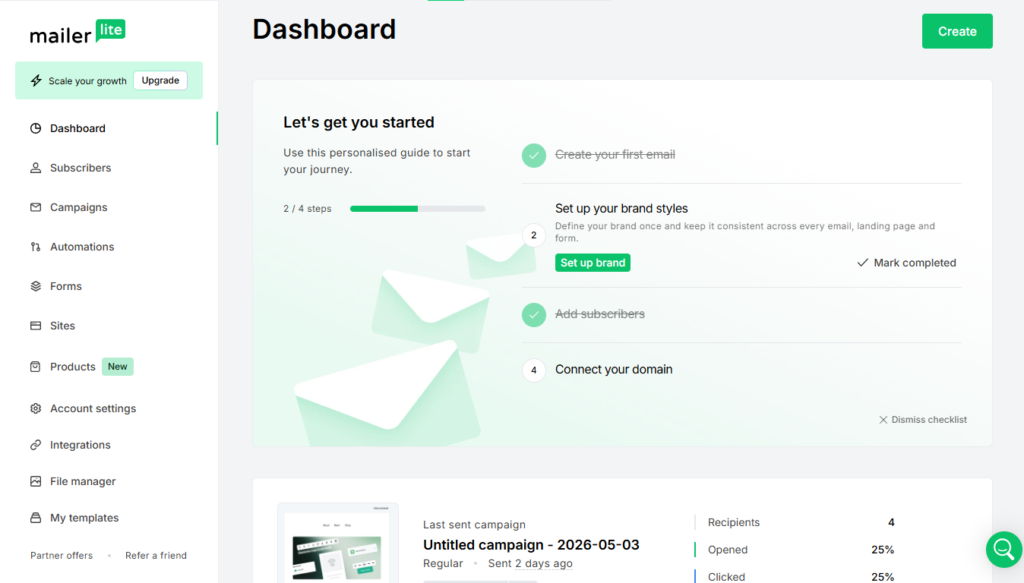
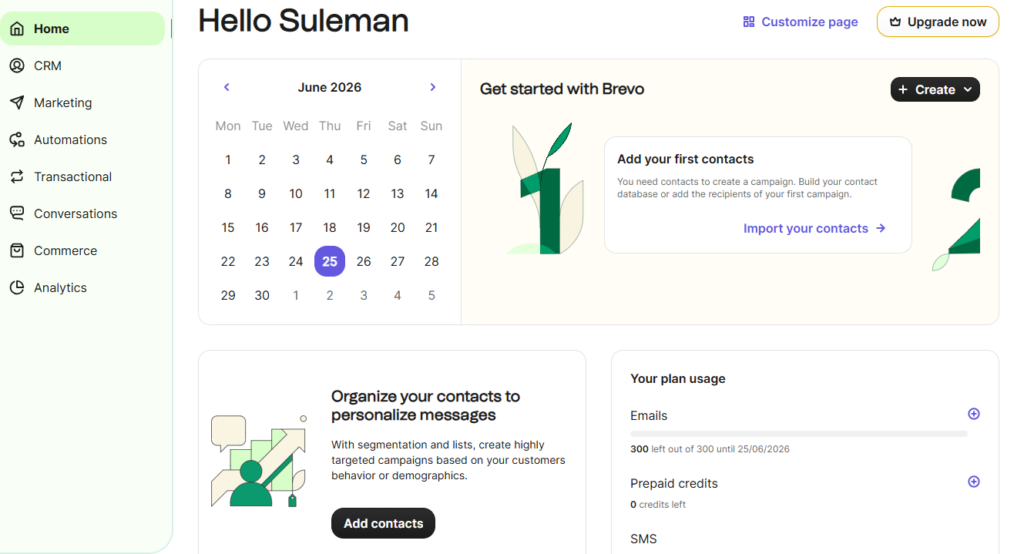
When people search MailerLite vs Brevo, ease of use is usually one of the first deciding factors. MailerLite explicitly describes itself as straightforward and user-friendly, and its help content says the key idea behind the product is simplicity. Brevo also emphasizes simplicity, but it has more modules, such as CRM, conversations, automation, plugins, and commerce, which naturally introduces more navigation depth.
Independent hands-on testing points in the same direction. EmailTooltester’s 2026 comparison says both tools are easy to use, but gives MailerLite a slight edge because of its cleaner interface and more visual email editing experience. That independent perspective matches what the official product structures suggest: MailerLite has fewer conceptual layers, while Brevo offers more breadth at the cost of a busier workspace.
MailerLite’s usability advantage
MailerLite’s big usability win is focus. The platform is organized around core creator-and-email workflows: campaigns, automations, subscribers, sites, forms, and monetization features. It also now offers three distinct editors, which reduces friction because different users can choose the best workflow instead of forcing every campaign through a single builder. In May 2026, MailerLite also upgraded its email editing experience with a new Simple editor and a rebuilt Custom HTML editor, further reinforcing its ease-of-use story.
Brevo’s usability trade-off
Brevo is still approachable, especially for a platform with this much surface area. Its pricing FAQ says even complete beginners can build emails, create contact lists, and set advanced preferences. But because Brevo spans marketing, CRM, automations, plugins, transactional messaging, conversations, and analytics, its interface asks users to think in a more cross-functional way. That is not inherently bad; it is simply more of a platform than some buyers need.
Verdict on ease of use
In a pure MailerLite vs Brevo beginner test, MailerLite wins for less cognitive overhead. In a broader operations test, Brevo can be easier than stitching together separate email, CRM, SMS, and transactional tools, because the complexity is centralized instead of fragmented. So the “easier” choice depends on whether you need a lightweight tool or a unified one.
Email Editor & Templates
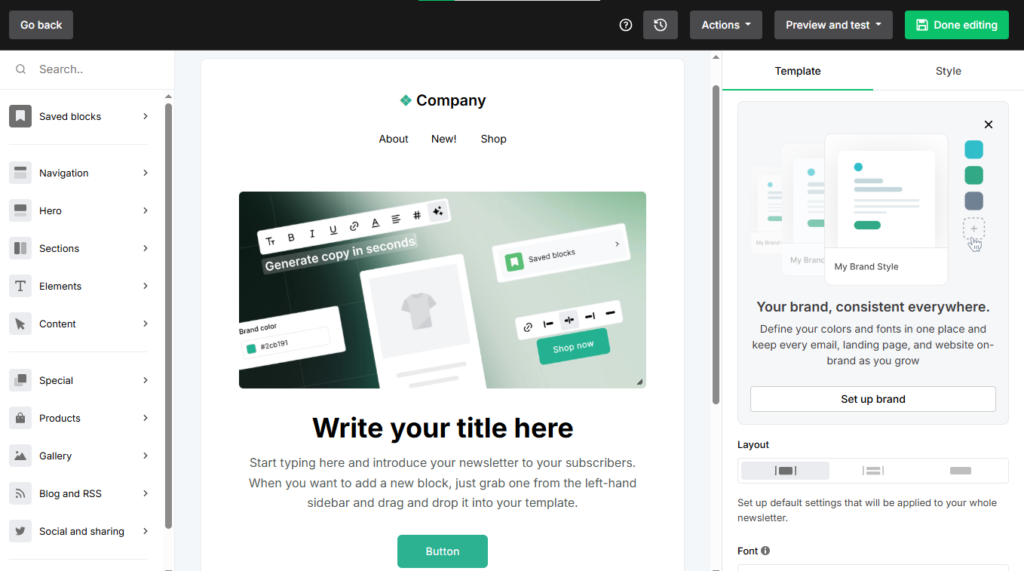
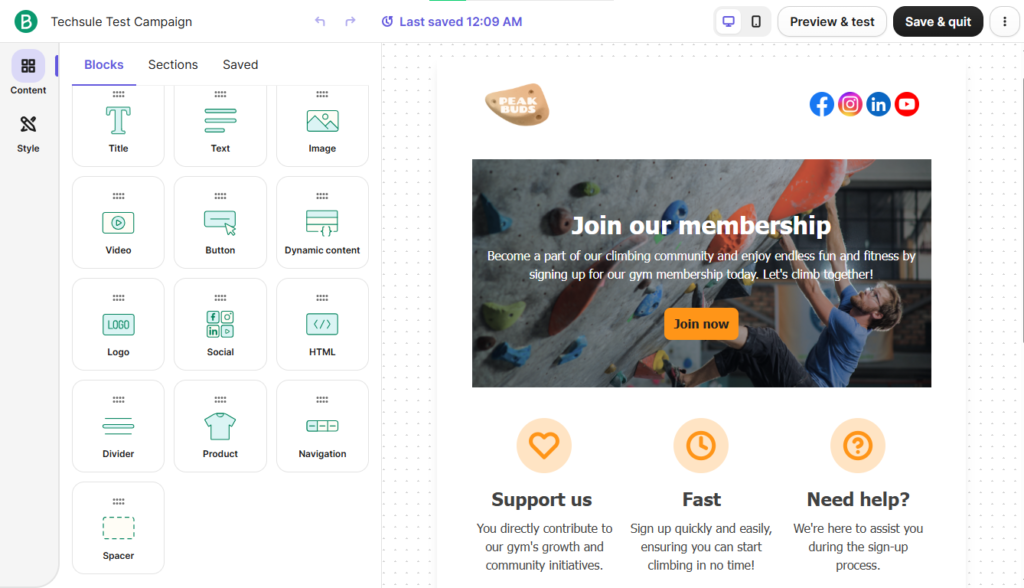
The editor experience is one of the most visible differences in MailerLite vs Brevo. MailerLite now offers three editor paths: a Drag & Drop editor for visual newsletters, a Simple editor for writing-first emails, and a Custom HTML editor with an AI agent for code-heavy work. Brevo also supports multiple creation modes, including drag-and-drop, a simple editor, and HTML custom code. Both platforms therefore cover beginners and advanced users, but MailerLite’s 2026 editor refresh makes its editorial workflow especially strong.
On templates, Brevo officially says it offers over 40 free responsive email templates. MailerLite positions templates more broadly across newsletters, landing pages, websites, and pop-ups, and repeatedly highlights a gallery of designer-made templates. MailerLite’s marketing pages also describe 150+ templates across those broader assets, not just emails, which is useful context when comparing the two tools.
Where MailerLite stands out
MailerLite’s strongest editor advantage is choice without clutter. The Simple editor is specifically designed for text-heavy newsletters and founder-style emails, while the Drag & Drop editor is better for image-rich layouts. Its Custom HTML editor now supports AI-assisted HTML generation from plain English and Canva ZIP imports, which is unusually practical for teams that switch between no-code and coded emails.
MailerLite also benefits from the fact that its landing pages, pop-ups, and email templates sit inside the same design-minded ecosystem. For content businesses and creators, that consistency often matters more than raw template count because it makes campaigns, forms, and pages feel like one branded funnel instead of disconnected assets.
Where Brevo stands out
Brevo’s editor is strong for operational email marketing. The drag-and-drop builder supports reusable sections, custom templates, and saved sections, which can save real time for teams sending recurring promotions, newsletters, and lifecycle campaigns. Brevo also layers AI into the editor experience with AI-generated subject lines and email content, and its simple editor makes cleaner plain-text-style emails possible when visual density is not the goal.
Verdict on email creation
For most publishers, creators, and small businesses, MailerLite has the more satisfying visual and writing experience. For teams that care about reusable email production inside a broader CRM/multichannel stack, Brevo is highly capable. In this section of MailerLite vs Brevo, MailerLite has the edge on feel, while Brevo remains very competitive on workflow discipline.
Email Campaign Management
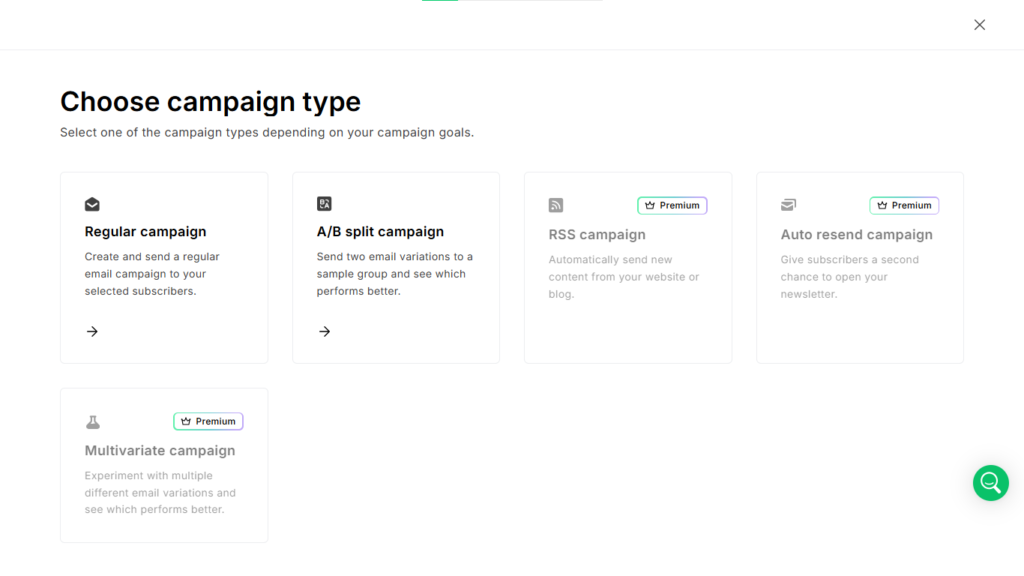
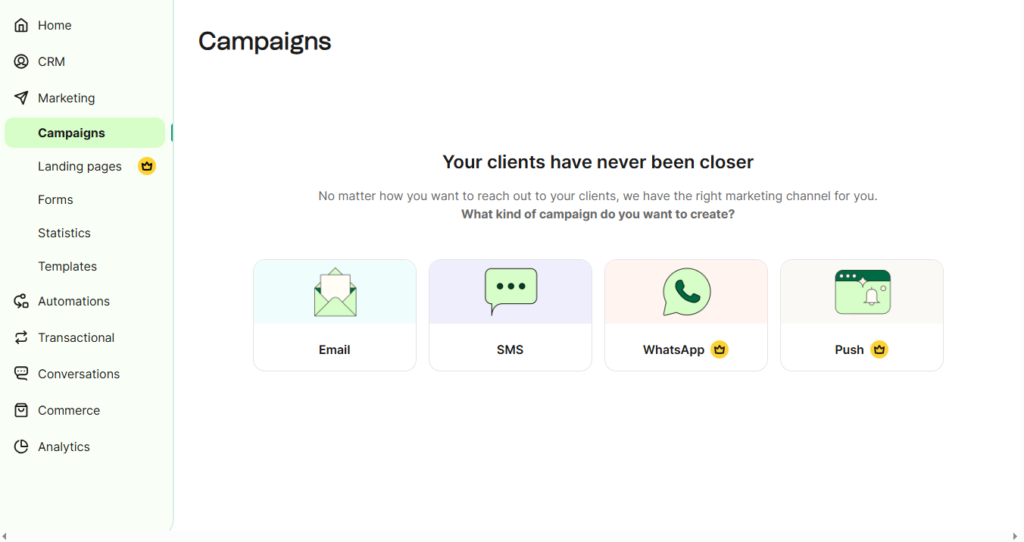
Campaign management in MailerLite vs Brevo is close enough that the “winner” depends on what kind of sending you do. MailerLite supports regular campaigns, visual editors, A/B testing, and smart sending. Brevo supports standard campaigns, A/B testing, AI-powered send-time optimization, and transactional email on all plans. Both platforms therefore satisfy common newsletter and promotional use cases well.
MailerLite campaign strengths
MailerLite’s campaign flow is straightforward: create a campaign, pick an editor, choose recipients, and schedule or send. It includes campaign A/B testing even on the updated free plan, and paid tiers add features such as auto-resend, multivariate testing, smart sending, and dynamic emails. For businesses that value fast campaign setup over deep orchestration, this is one of the strongest reasons to choose MailerLite in a MailerLite vs Brevo comparison.
Brevo campaign strengths
Brevo’s campaign management becomes more compelling when timing and lifecycle coordination matter. Its “Send at best time” capability uses Aura AI to analyze engagement data and determine when each contact is most likely to engage. Brevo also emphasizes transactional emails on all plans, including API access, SMTP, outbound webhooks, and integrations with major CMS tools, which is a major advantage for software businesses, stores, and products that need operational messaging alongside marketing campaigns.
Which platform handles day-to-day campaigns better?
If your team sends mostly newsletters, launches, promotions, and simple A/B tests, MailerLite is usually the faster and calmer tool. If your sends are tied more tightly to customer events, product events, support flows, or multichannel lifecycle steps, Brevo offers more campaign-management context around the email itself. That is a recurring theme throughout MailerLite vs Brevo: MailerLite makes campaign work simpler, while Brevo makes campaign work part of a larger operating system.
Comparison callout: MailerLite is usually better for marketers who think in terms of newsletters and funnels. Brevo is usually better for marketers who think in terms of customer journeys and touchpoints.
Marketing Automation
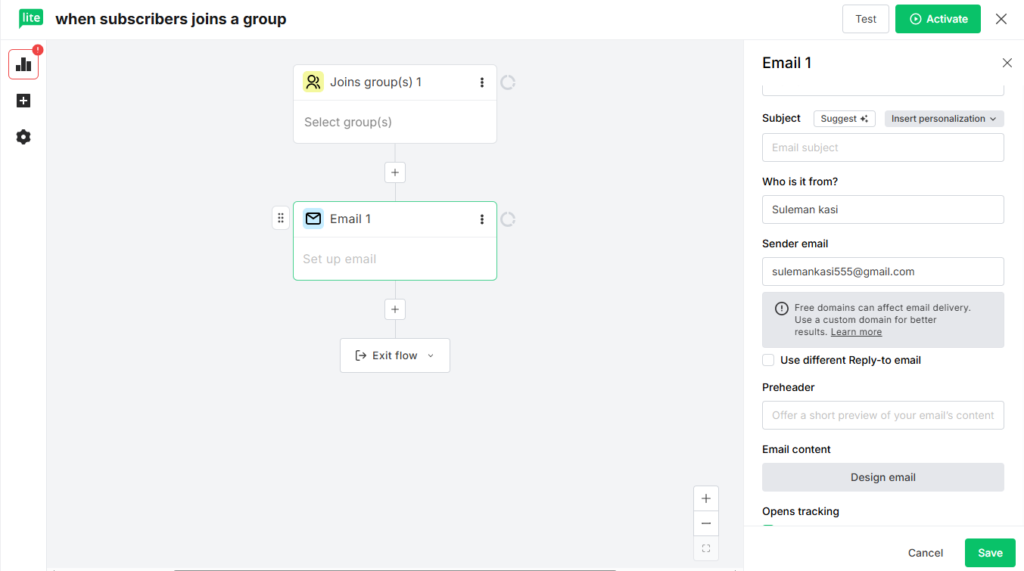
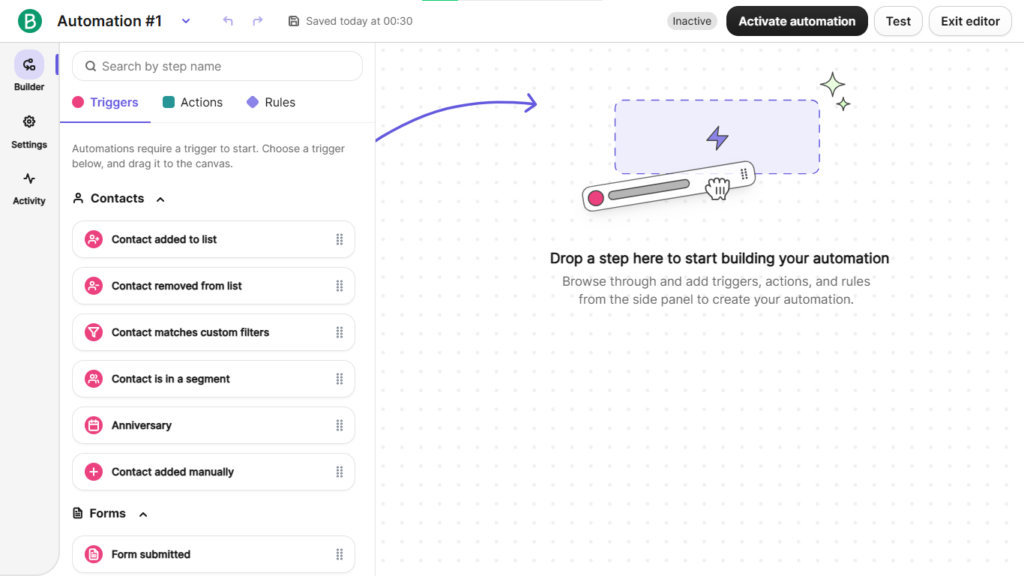
Automation is where MailerLite vs Brevo starts to separate more clearly by use case. MailerLite gives you visual automations, rules, actions, templates, and a growing list of e-commerce triggers. Brevo gives you multichannel automations with emails, SMS, website tracking, abandoned cart flows, page-visit follow-ups, and lead scoring examples. For simple to mid-level automation, both work. For broader customer-journey automation, Brevo is the stronger platform.
MailerLite automation strengths
MailerLite’s automation builder uses rules and actions, and its help center shows support for triggers including e-commerce purchase behavior, abandoned checkout, category purchases, purchase frequency, and other workflow steps. That is enough for welcome sequences, nurture funnels, simple e-commerce behavior flows, and creator-style onboarding. On paid plans, Power adds unlimited automations and multiple automation triggers, while Comfort includes limited visual automations.
Recent product updates also show MailerLite extending automations into monetization. In April 2026, it added ways to promote digital and booking products directly from product pages and open pre-populated automations tied to purchase history. That matters because it shows MailerLite’s automation roadmap leaning into creator commerce, not just newsletter sending.
Brevo automation strengths
Brevo’s automation capabilities are broader in both triggers and channels. Official help examples include welcome and onboarding messages, abandoned cart reminders, birthdays and anniversaries, page-visit follow-ups, contact/blocklist management, and lead scoring. Its pricing pages also distinguish between the free plan’s automation limit of up to 2,000 contacts and the Standard plan’s automation for unlimited contacts. That gives growing businesses more headroom than many low-cost email tools.
The inclusion of website tracking is especially important. Brevo’s tracker can capture page visits and actions taken on the website, then feed those signals into segments and automations. That makes Brevo the better option in MailerLite vs Brevo when behavior-based lifecycle marketing is central to your strategy.
Automation verdict
MailerLite is very good for marketers who want visual automations without much operational overhead. Brevo is better when automation needs to extend beyond email into website behaviors, CRM context, or multichannel actions. If automation is one of your top two buying criteria, Brevo is usually the safer long-term bet unless you are a creator or content-led business that values simplicity above breadth.
Subscriber Management & Segmentation
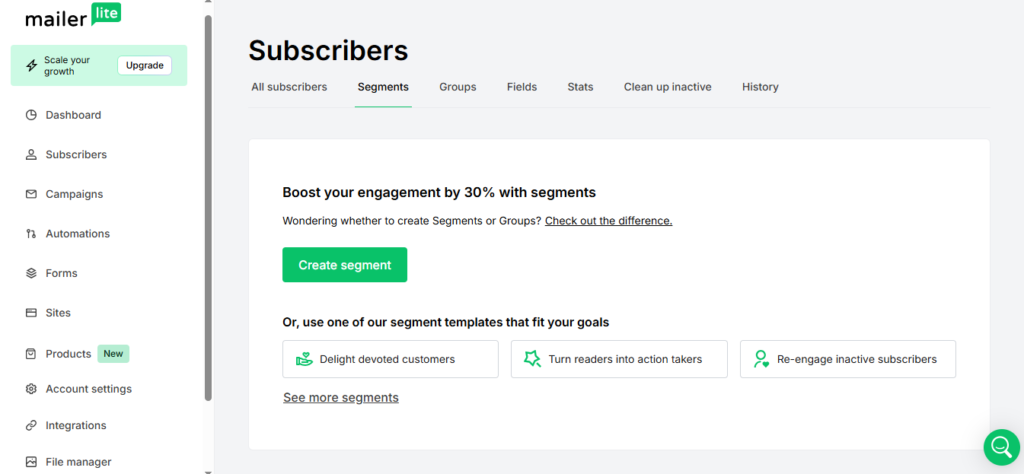
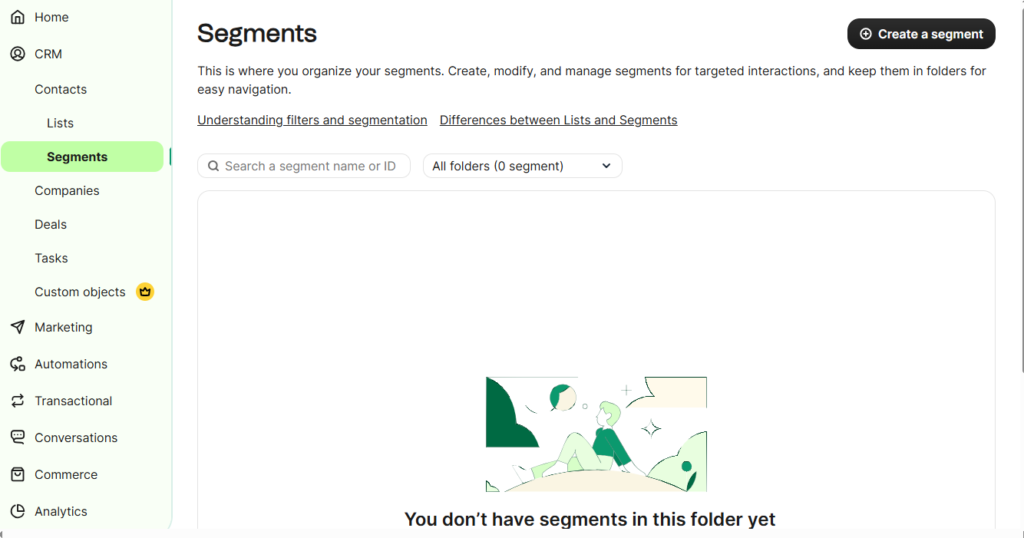
Subscriber organization is another important section in MailerLite vs Brevo because both tools are priced and structured differently. MailerLite relies on subscribers, groups/tags, segments, custom fields, and subscriber management tools. Brevo separates lists and dynamic segments, supports contact attributes, and ties segmentation closely to CRM and behavioral data.
MailerLite segmentation model
MailerLite’s segmentation is strong for conventional email marketing. Its official segmentation page says segments update automatically as your list changes, and its interest groups let you tag subscribers based on interests or behaviors. It also supports custom fields, which is enough for personalization, filtering, and many creator- and small-business targeting needs.
One nice practical advantage is that MailerLite keeps this model conceptually simple. You can think in terms of “groups for intent” and “segments for rules,” which is easier for smaller teams to maintain consistently than more CRM-heavy contact structures.
Brevo segmentation model
Brevo’s segmentation model is more dynamic and more CRM-aware. Its help docs define segments as dynamic groups that update automatically when contacts match or stop matching conditions. It also supports contact attributes, which can store custom data about preferences, purchases, responses, or other account-specific fields. Combined with web tracking and CRM-level contact objects, Brevo gives marketers more ways to define and update audiences in real time.
Verdict on audience management
For standard newsletter targeting, both tools are good. For advanced real-time segmentation tied to behavior, website activity, and broader customer data, Brevo is stronger. In a MailerLite vs Brevo decision, MailerLite wins on simplicity of list logic, while Brevo wins on segmentation sophistication.
Landing Pages & Forms
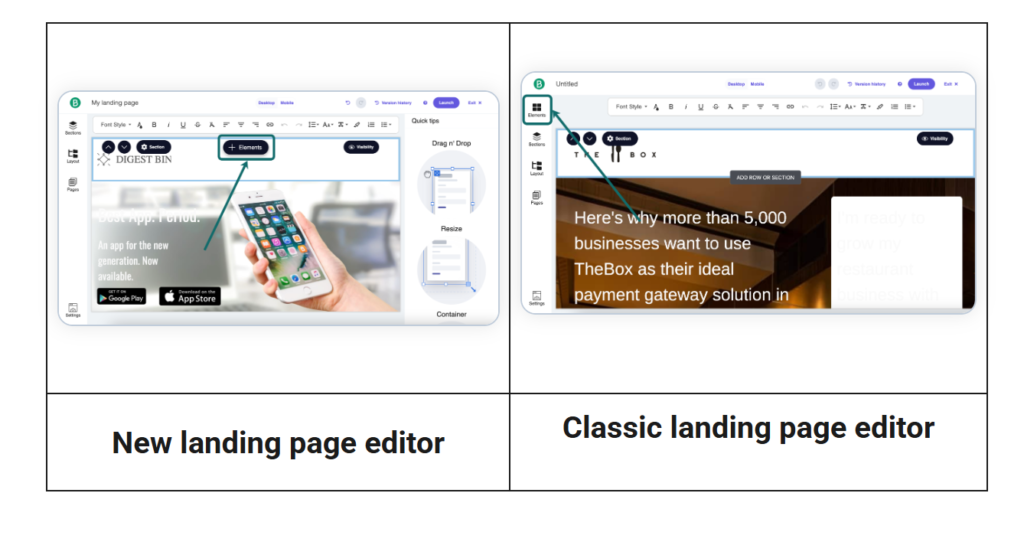
Landing pages and signup forms often decide MailerLite vs Brevo for lead-generation-heavy businesses. MailerLite gives you a website builder, landing pages, pop-ups, blogs, and form tools under the same product umbrella. Brevo also supports embedded forms, pop-up forms, landing pages, custom domains, and even SEO considerations for pages, but MailerLite’s website-and-publisher toolkit feels more central to its identity.
MailerLite’s page and form advantage
MailerLite’s newer landing page builder includes an updated UI, reusable blocks, 70+ premade blocks, and customizable templates. Its official help content also includes direct SEO settings for page title and related search metadata, which is useful for organic acquisition. On the forms side, MailerLite supports embedded forms, pop-ups, promotion pop-ups, teaser pop-ups, and even more promotional styles like spin-the-wheel.
One caution is that MailerLite’s free-plan limits changed in June 2026 and additional feature-use limits were planned for August 2026. As of June 25, 2026, free users had one landing page, one website, and limits on automations and forms either active already or announced as upcoming enforcement. Verify current pricing and features before publishing because this area is actively changing.
Brevo’s forms and pages
Brevo supports both full-page/embedded signup forms and pop-up forms, including double opt-in options and GDPR fields. Its landing-page flow supports templates, pages from scratch, publishing, custom domains or subdomains, and iframe embedding into an existing website. So Brevo covers the essentials well, especially for businesses whose forms and landing pages support a broader CRM or multichannel system rather than acting as the core product experience.
Verdict on landing pages and forms
If lead capture pages, simple websites, blogs, and brand-consistent creator funnels are central to your business, MailerLite is usually the stronger choice in MailerLite vs Brevo. If you just need competent forms and landing pages inside a larger customer platform, Brevo is more than sufficient.
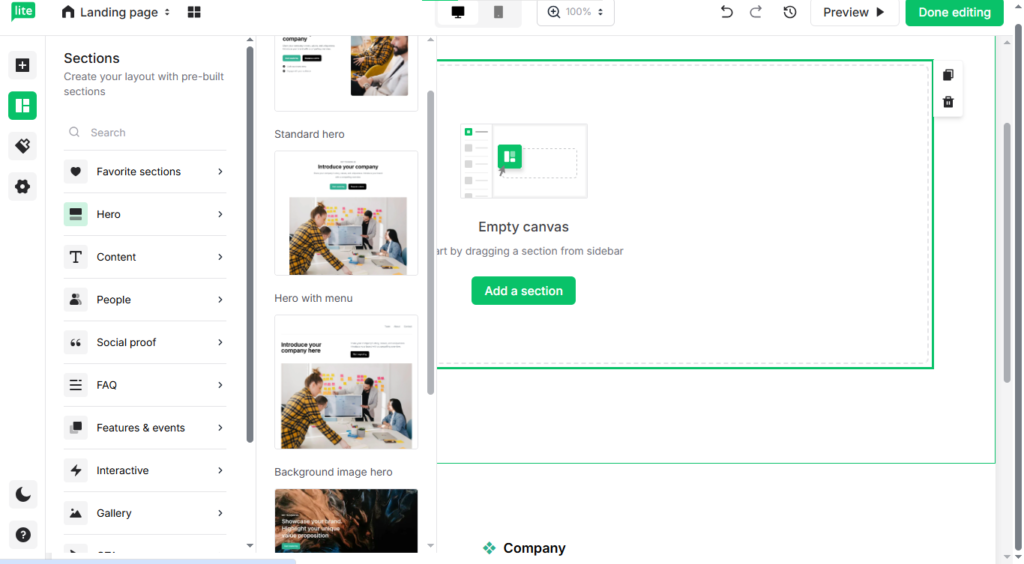
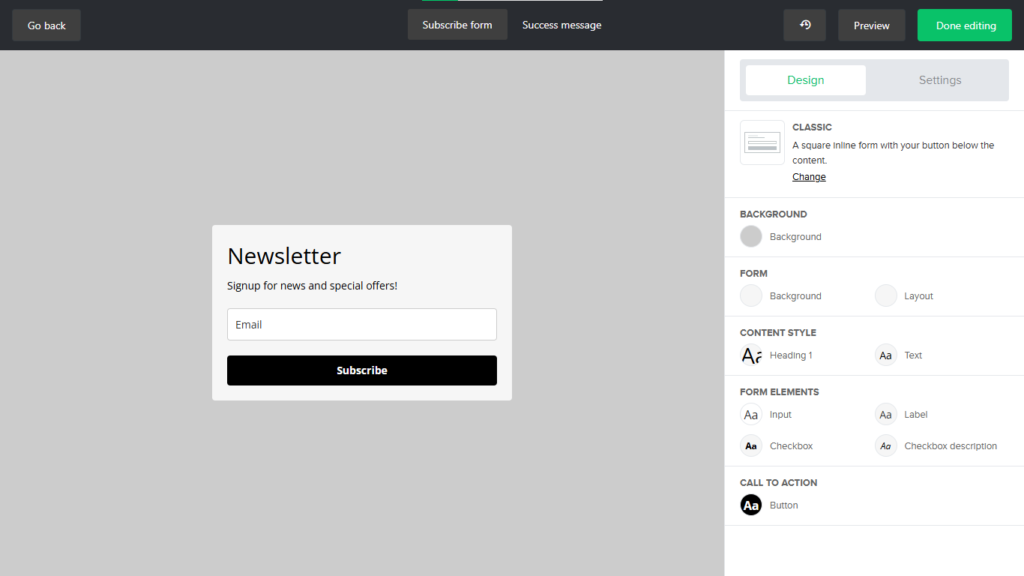
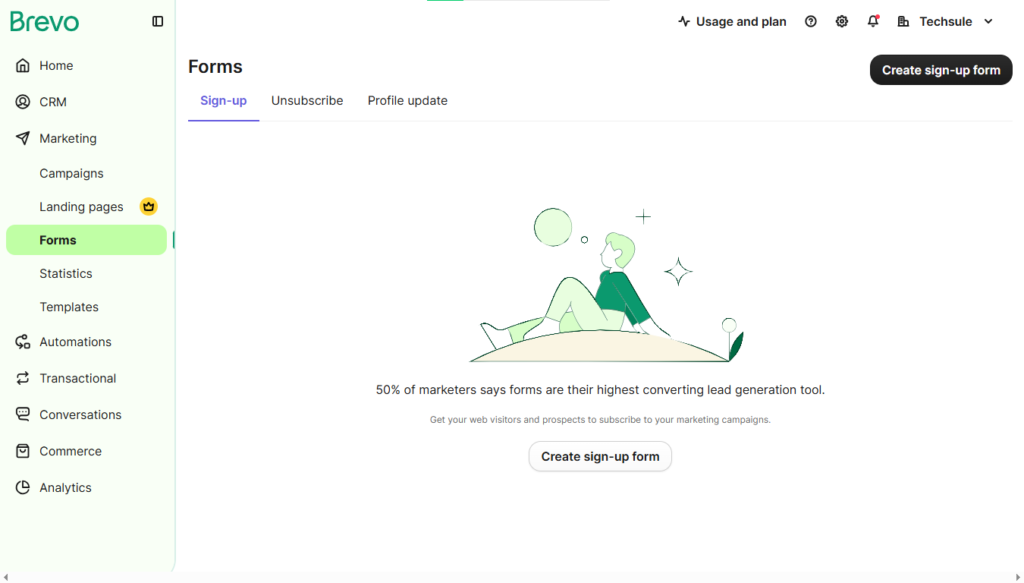
Beyond landing pages, both platforms offer built-in form builders designed to collect leads and grow subscriber lists. MailerLite focuses on simplicity and ease of use, whereas Brevo connects forms more deeply with its CRM and broader customer engagement tools.
Integrations
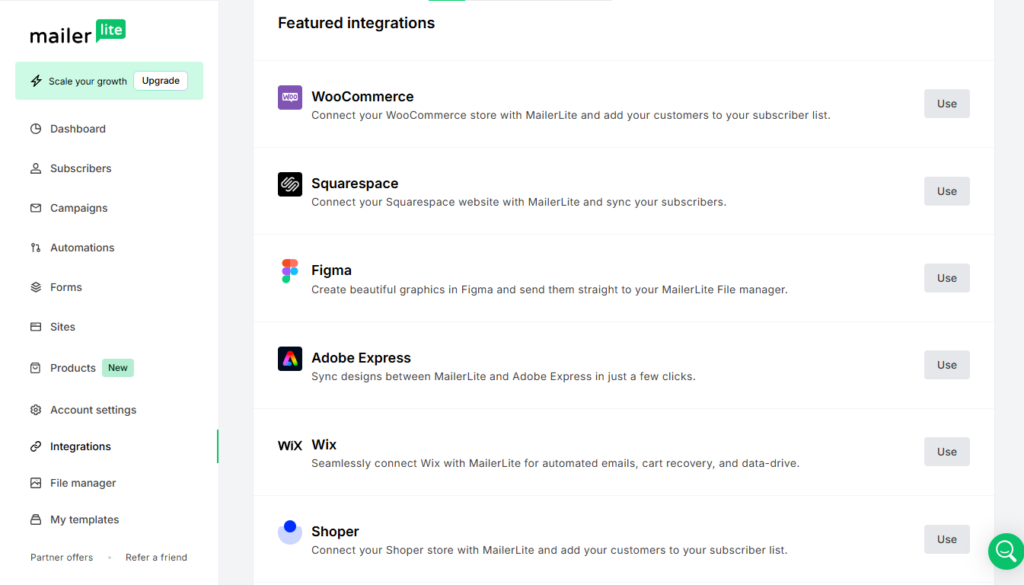
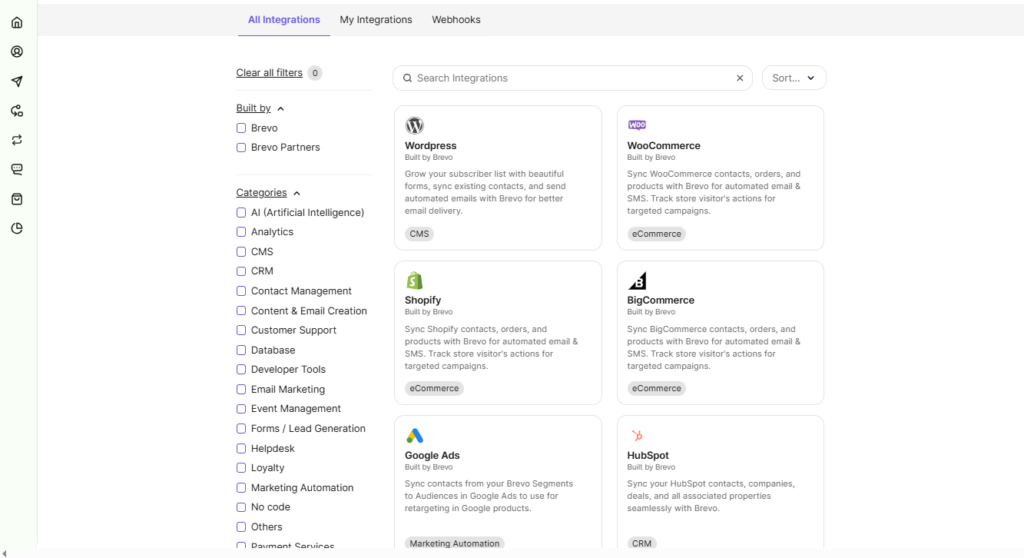
On integrations, MailerLite vs Brevo is closer than some people expect. MailerLite’s integrations directory covers multiple categories and prominently features Shopify, WordPress, WooCommerce, Stripe, Zapier, Make, ChatGPT, and Claude. Its directory also notes Zapier access to 5,000+ apps, plus over 100 native integrations mentioned across product materials. Brevo supports WordPress and WooCommerce plugins, Shopify-related integrations, an app ecosystem, open API docs, SDKs, and transactional tooling.
MailerLite integration fit
MailerLite’s integration story is strongest for marketers who live in website, store, and automation ecosystems. Its native integrations with Shopify, WooCommerce, and WordPress are clear and practical, and the product emphasizes streamlined connections for e-commerce data, abandoned cart flows, purchase tracking, and subscriber capture. If you already use no-code tools like Zapier or Make, MailerLite is easy to extend.
Brevo integration fit
Brevo’s integration story is stronger for technical and cross-channel teams. Its API documentation covers email, SMS, WhatsApp, contact management, events, e-commerce syncing, and custom objects. It also has official SDKs in major languages, plus WordPress and WooCommerce plugins that support forms, subscriber sync, push notifications, customer and order syncing, and targeted campaigns. That makes Brevo especially compelling in MailerLite vs Brevo for SaaS, stores, and teams with product or engineering support.
Verdict on integrations
MailerLite is excellent for the average small business integration stack. Brevo is stronger for businesses that treat integrations as infrastructure, not just add-ons. If you expect marketing, product, and transactional messaging data to coexist, Brevo has the edge.
Analytics & Reporting
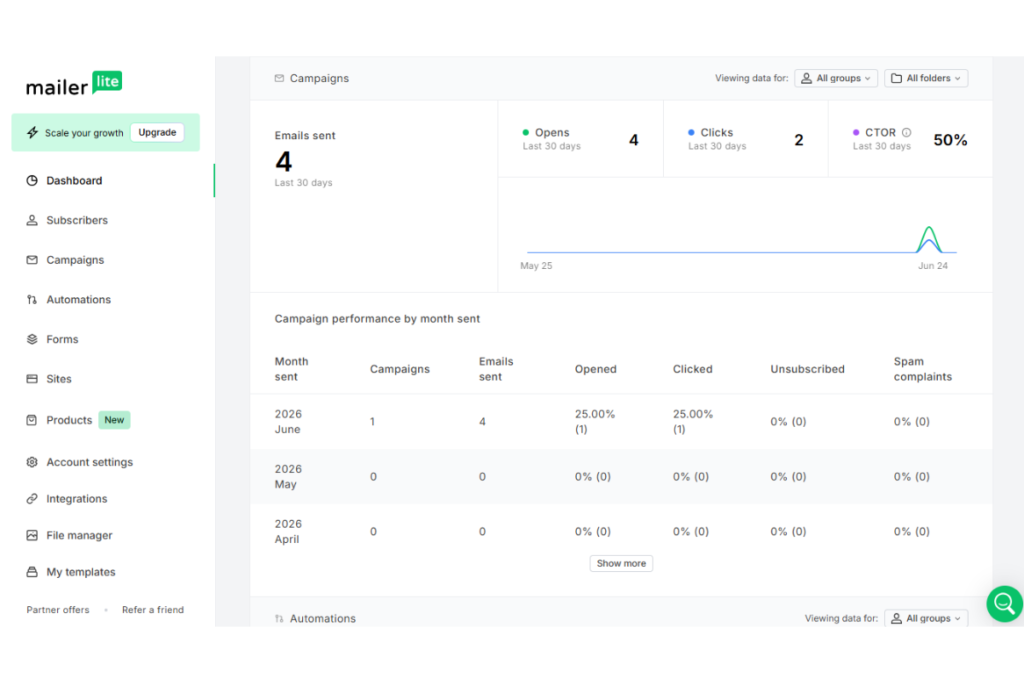
Reporting is a growing differentiator in MailerLite vs Brevo. MailerLite now offers custom reports, comparative reporting, click maps, e-commerce tracking, group/time-period filters, and AI-assisted analysis through its MCP integrations. Brevo offers basic and advanced analytics by plan, AI send-time optimization, and a separate Analytics environment with dashboards, BI features, custom reporting, and alerts on higher tiers.
MailerLite reporting strengths
MailerLite’s reporting has improved meaningfully in 2026. Its custom reports allow you to build dashboards by subscriber group, campaign type, or time period, while e-commerce tracking connects purchases back to campaign reports. MailerLite also explicitly warns users that Apple Mail Privacy Protection inflates open-rate visibility, which is a good sign that the product is not treating vanity metrics as the whole story.
Brevo reporting strengths
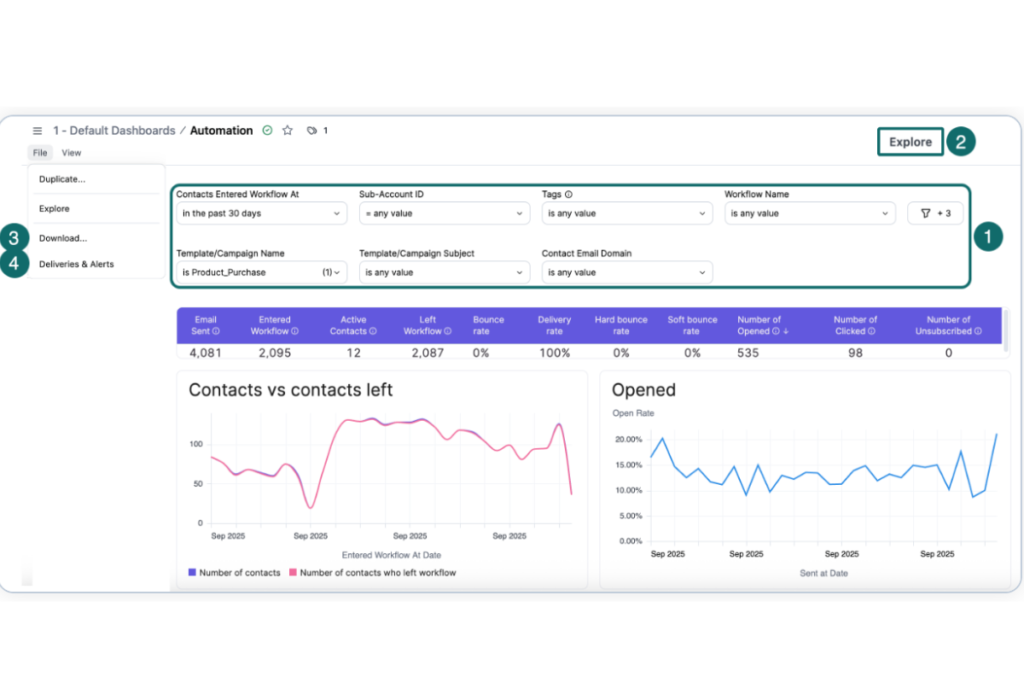
Brevo’s reporting becomes stronger as you move up plans. Free includes basic reporting and analytics, Standard includes advanced reports and analytics, and Professional adds Analytics Studio with dashboards. Official help also describes Analytics as a built-in BI platform that turns raw data into actionable insights and supports custom reporting plus real-time alerts. If you want reporting that moves beyond campaign stats into a more unified business view, Brevo is usually the more capable option.
Deliverability context
Reporting quality matters because deliverability is not static. Validity’s 2025 benchmark report says inbox placement declined in 2024 and that deliverability is getting tougher amid mailbox requirements and changing user behavior. In ESP-specific independent tests, EmailTooltester reported MailerLite with a 94.41% average deliverability rate over five rounds and Brevo at 88.3% in the January 2024 round, though those test results should be treated as historical snapshots rather than live guarantees for 2026.
Verdict on analytics
MailerLite’s reporting is strong enough for most marketers and better than many buyers assume. Brevo’s reporting ceiling is higher, especially for cross-channel or higher-volume teams that want more analytics structure. In MailerLite vs Brevo, MailerLite wins for clarity; Brevo wins for depth.
Pricing & Plans
Pricing is one of the biggest search-intent drivers behind MailerLite vs Brevo, and it is also where the two products use fundamentally different logic. MailerLite prices primarily around subscriber counts and sending volume by plan, while Brevo prices primarily around email volume and plan features, with contacts stored as a separate tiering factor. That means the cheaper option depends heavily on your sending pattern, not just your list size.
As of June 25, 2026, MailerLite’s free plan had recently changed. Brevo’s free and paid plans also include multiple tiers and add-ons. Verify current pricing and features before publishing because both companies update packaging, limits, and included features over time. MailerLite explicitly changed its free plan on June 16, 2026, and planned additional feature-use enforcement in August 2026.
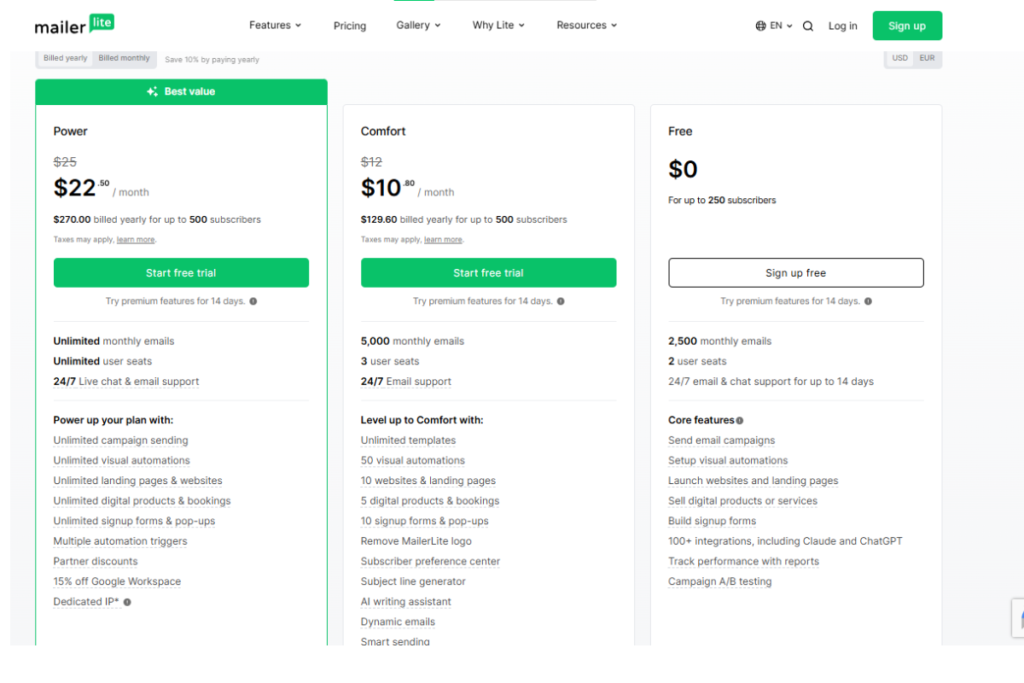
| Platform | Free Plan Limits | Pricing (Annual Billing) | Notable Paid Features |
|---|---|---|---|
| MailerLite | Free plan includes up to 250 active subscribers, 2,500 monthly emails, 2 user seats, campaigns, visual automations, forms, websites/landing pages, reports, and campaign A/B testing. | Growing Business starts at $10 per month; Advanced starts at $20 per month. | Growing Business adds unlimited email sends, unlimited templates, AI writing assistant, dynamic content, smart sending, and more. Advanced adds enhanced automation, custom HTML editor, preference center, and advanced reporting features. |
| Brevo | Free plan includes 300 emails/day, storage for up to 100,000 contacts, 1 user seat, email campaigns, SMS campaigns, CRM, drag-and-drop editor, transactional emails, and automation for up to 2,000 contacts. | Starter starts at $8 per month; Business starts at $16 per month; Professional starts at $449 per month. | Starter removes daily sending limits. Business adds landing pages, advanced automation, A/B testing, AI send-time optimization, and advanced analytics. Professional adds custom dashboards, multi-channel marketing, phone support, and dedicated deliverability assistance. |
Note: Prices shown are based on annual billing and may change over time.
The screenshots below compare the current pricing plans of MailerLite and Brevo, highlighting their available features, plan tiers, and starting costs.
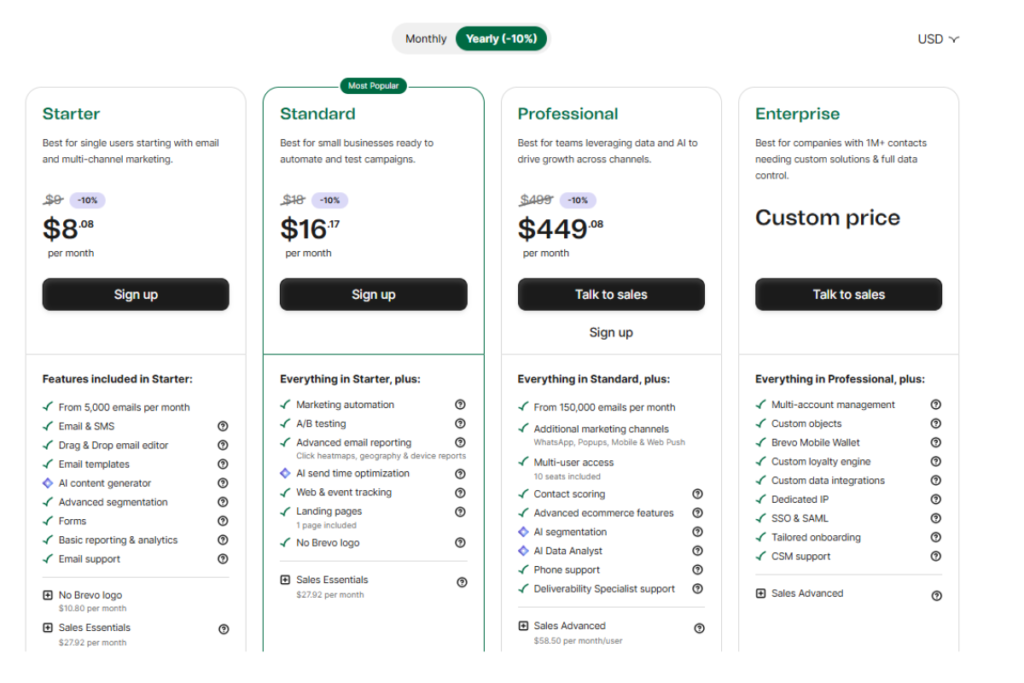
How to interpret the pricing
MailerLite is often cheaper for smaller, more engaged lists that send often and benefit from subscriber-based pricing plus unlimited sending on Power. Brevo is often cheaper when you have a large contact database but do not email everyone frequently, because its model is more volume-centric and it also offers pay-as-you-go logic for infrequent senders. EmailTooltester’s comparison specifically highlights this difference as one of Brevo’s major advantages.
Free-plan value
MailerLite’s new free plan became more feature-rich in some ways while becoming more restrictive in subscriber and email volume. The platform says it unlocked more tools like custom templates, blogs, promotional pop-ups, and the Custom HTML editor, but cut the limit from 500 to 250 active subscribers and from 12,000 to 2,500 monthly emails. Brevo’s free plan remains attractive for businesses that want to store a very large contact base, but its 300-email daily cap is restrictive if you send regular newsletters to more than a few hundred people.
Pricing verdict
In MailerLite vs Brevo, there is no universal pricing winner. Choose MailerLite if you are list-size conscious, send often, and want monetization features bundled into the platform. Choose Brevo if you have a larger database, need multichannel or transactional messaging, or send less frequently and want pricing that follows send volume more than subscriber count.
Customer Support
Support matters more in MailerLite vs Brevo than many comparison posts admit, because email marketing problems can affect revenue, deliverability, and launch timing. MailerLite’s support model is more plan-dependent: Comfort and Power get 24/7 email support, while Power also gets 24/7 live chat. Free-plan users are mainly directed to the community, knowledge base, tutorials, and academy.
Brevo takes a broader support-and-resources approach. Free includes email support, Standard includes priority email support, and Professional includes phone plus priority email support. Brevo also has a Help Center, Academy, API docs, contact options, and partner/expert resources.
Support verdict
MailerLite’s support looks stronger for users on its higher plans who want 24/7 responsiveness in an email-first product. Brevo’s support ladder is compelling for companies that want phone support on higher tiers and a larger ecosystem around implementation. For many small teams, MailerLite’s support will feel more personal and product-specific; for larger or more technical setups, Brevo’s broader support model may align better.
Pros and Cons
The clearest way to summarize MailerLite vs Brevo is to compare practical trade-offs, not marketing claims. The table below is an editorial synthesis based on the official product documentation and recent independent testing already cited in this draft.
| MailerLite | Brevo | Notes/When it matters |
|---|---|---|
| Easier for beginners and creators | Broader but busier interface | MailerLite usually wins if you want low-friction email marketing. Brevo usually wins if you want more channels and objects in one platform. |
| Stronger publishing toolkit with blogs, landing pages, forms, and creator monetization | Stronger multichannel stack with SMS, WhatsApp, push, CRM, chat, and transactional messaging | Choose based on whether your center of gravity is content publishing or customer operations. |
| Better fit for paid newsletters, digital products, and bookings | Better fit for lifecycle marketing plus sales/CRM use cases | MailerLite’s built-in monetization features are a real advantage for creators and educators. Brevo’s CRM and multichannel tools matter more for shops, SaaS, and service businesses. |
| Refreshed editor experience in 2026; strong visual and writing workflows | Excellent operational email builder with reusable sections and AI send-time tools | MailerLite feels better for editorial work; Brevo feels better for structured campaign production. |
| Subscriber-based pricing can work well for engaged lists and frequent senders | Email-volume pricing can work well for large lists and infrequent senders | Pricing advantage depends on your sending pattern, not just your account size. |
| Free plan recently became more feature-rich but also more restrictive | Free plan stores many contacts, but daily sending caps are tight | This is a major decision point for startups and early-stage projects. |
| Solid reporting with new custom reports and e-commerce tracking | Higher reporting ceiling with analytics platform and dashboards on upper tiers | MailerLite is clearer; Brevo is deeper. |
| Better independent historical deliverability trend in EmailTooltester tests | More variable historical deliverability in EmailTooltester tests | Useful directional signal, but not a live guarantee for future inboxing. |
Bottom line on pros and cons
If your short list is down to MailerLite vs Brevo, the pros and cons are less about raw feature count and more about operational philosophy. MailerLite removes friction. Brevo removes tool fragmentation. The best choice is whichever one solves the bigger pain in your business today.
Who Should Choose MailerLite?
Choose MailerLite if your business is content-led, audience-led, or creator-led. It is especially well suited to bloggers, newsletter operators, consultants, coaches, educators, small stores, and lean teams that want to build attractive campaigns, forms, landing pages, and simple automations without adopting a larger CRM stack. Its blog-building, digital product, paid subscription, and bookings features make it unusually well aligned with businesses that monetize expertise or content directly.
MailerLite is also a strong fit if you value writing and visual design workflows. The combination of the Simple editor, Drag & Drop editor, and Custom HTML editor means different campaign styles can live comfortably in one tool. That matters for founders, creators, and publications that alternate between plain-text-feeling notes, designed newsletters, and custom coded sends.
Finally, choose MailerLite if you want a platform that feels like it was built by people who understand audience growth, not just contact management. In a MailerLite vs Brevo evaluation, MailerLite is the better choice when simplicity, publishing, visuals, and monetization are more important than CRM breadth.
Who Should Choose Brevo?
Choose Brevo if you want one platform to handle more of the customer lifecycle. Brevo is the better fit for businesses that need email marketing plus CRM, SMS, WhatsApp, push notifications, forms, landing pages, transactional messaging, and API-level extensibility. This profile includes SaaS companies, ecommerce brands, service businesses with sales pipelines, and teams that are trying to consolidate multiple tools into one operational layer.
Brevo is also the smarter pick if segmentation and automation are closely tied to customer behavior, page visits, or large contact stores. Its tracking, dynamic segmentation, contact attributes, and lifecycle use cases make it more adaptable when your marketing becomes more behavioral and less purely editorial.
Brevo can also be the better pricing fit if you maintain a relatively large database but do not email every contact frequently. That pricing asymmetry is one of the most practical reasons people choose Brevo in a MailerLite vs Brevo comparison. Add transactional email and API support on all plans, and the case becomes even stronger for product-driven businesses.
Final Verdict: Is MailerLite or Brevo Better in 2026?
The most honest final answer to MailerLite vs Brevo in 2026 is this: MailerLite is better for simplicity, creators, publishers, and small teams that want to turn email, pages, and audience assets into revenue quickly. Brevo is better for multichannel lifecycle marketing, CRM-aware segmentation, and businesses that want email to sit inside a larger customer platform.
If you are publishing a newsletter, building lead magnets, selling digital offers, launching coaching or consulting funnels, or just want the most intuitive workspace, MailerLite is usually the better recommendation. If you need automation tied to website behavior, built-in CRM context, transactional email, SMS/WhatsApp, or a better fit for more complex customer journeys, Brevo is usually the better recommendation.
So the final winner in MailerLite vs Brevo depends on what you are optimizing for:
Best for creators and simple email marketing: MailerLite.
Best for multichannel customer engagement and lifecycle marketing: Brevo.Related Email Marketing Comparisons